On March 6, 2026, barely a week into the
US-Israeli joint military strike on Iran, US President Donald Trump declared “There will be no deal with Iran except UNCONDITIONAL SURRENDER!
Writing on his Truth Social
platform, Trump said: "After that, and the selection of a GREAT &
ACCEPTABLE Leader(s), we, and many of our wonderful and very brave allies and
partners, will work tirelessly to bring Iran back from the brink of destruction,
making it economically bigger, better, and stronger than ever before.
"IRAN WILL HAVE A GREAT
FUTURE. MAKE IRAN GREAT AGAIN (MIGA!)."
By March 15, he was already hinting of a deal with Iran and on March 23 he formally announced of
ongoing talks for a settlement, putting on hold all military strikes against
Iranian power plants and energy infrastructure he threatened to unleash.
On March 1, a day after the military operation was
launched against Iran, Trump said combat operations will continue until all of our objectives are
achieved. When asked to specify how long the war would continue, Trump said:
"Well, we intended four to five weeks." He reiterated this on
several occasion.
On March 13, when asked about how long the war will last,
Trump told reporters, "I can't tell you that. I
mean, I have my own idea. But what good does it do? It'll be as long as it's necessary."
But on March 21, in a startling message on Truth Social, that
largely went unnoticed and unreported by the media, Trump said that the United
States was considering “winding down” the military
operation in Iran.
In the same Truth Social post,
Trump said “The Hormuz Strait will have to be guarded and policed, as
necessary, by other Nations who use it — The United States does not!”,
indicating a rush to exit the combat, leaving the Hormuz crisis unresolved.
Notwithstanding Trump’s public grandstanding
and claims of victory, his intermittent threat to annihilate Iran, erase a
whole civilization and even blow-up Oman, was only indicating a growing
frustration with the status quo and a restless quest for a “deal” they can sell
as an honorable exit from the quagmire.
The US Vice President JD Vance in a way
confirmed this during a news conference at the White House on June 18 when he
said the current memorandum of understanding (MOU) between US and Iran was the best option
US has to end the war.
From calling for Iran’s unconditional
surrender and regime change to a breathless hunt for a deal, what led to this
surprise turn. Three weeks into the fight, why Trump was considering winding
down the combat operation.
Asia Council’s West Asia analysts take a
deeper look.
Intelligence failure or tactical error
36 hours after US and Israel launched the
combat operation against Iran eliminating its supreme leader, in a televised
speech US President Donald Trump said, “Iran's
formerly supreme leader, Ayatollah Khamenei, is dead. Last night, all over
Iran, the voices of the Iranian people could be heard cheering and celebrating in the streets when his death was announced. The entire military command is gone as
well, and many of them want to surrender into saving their lives. They want
immunity. They're calling by the thousands.”
The reality on the ground was very different.
Thousands were out in the streets of Iran mourning the death of their leader
Ayatollah Ali Khamenei.
Beside being the political head of the state
of Iran and its top Shia cleric as the Grand Ayatollah, Ali Khamenei was also
one of the most prominent religious figures in the Shia world, commanding
millions of followers.
His killing galvanized the Shia population
inside and outside Iran.
The supreme religious authority of Shias
Grand Ayatollah Ali-al Sistani soon issued a fatwa for standing in solidarity with
Iran. The fatwa urged Muslims to take to the streets and
public squares in demonstrations supporting Iran and the Islamic system, saying
that maintaining the stability of the Islamic system and preventing what it
described as “division conspiracies” requires a “broad public presence and
popular solidarity in the public squares,” considering this a collective
religious obligation.
This popular upsurge in Iran
was hardly understood by the US administration. Trump went as far as mocking
the crowd in Iranian streets as AI-generated.
The killing of the 86-year-old supreme leader
along with other key figures was viewed by the Iranian public as a “supreme
martyrdom” central to the Shia theology. It triggered a massive nationwide
consolidation the United States have never anticipated.
With the killing of the supreme leader and
other key functionaries, the US was expecting the Iranian state structure to
collapse. Hinging on their understanding of the December-January Iranian
protest, the United States assumed the discontent among the Iranians would be
strong enough to propel them to take over the rein once the leadership is
eliminated. Trump was possibly made to believe that it would be a swift
military campaign and a rerun of the fall of Saddam and Gaddafi.
But what happened, turned out to be a major
tactical blunder based on ill-informed strategic thinking and decision making.
US combat losses
According to the May 13 US
Congressional Report, 42 US aircraft, including uncrewed aircraft (i.e., drones),
were reportedly lost or damaged in the 40-day US-Israeli military
operation against Iran under the designation Operation Epic Fury.
During a May 12, 2026, hearing, Acting
Pentagon Comptroller Jules W. Hurst III testified that the
department's cost estimate for military operations in Iran has increased to $29
billion. But US economists, experts and lawmakers believe this to be a
significant underestimate. The actual cost to the US economy could amount to between $630bn and $1 trillion.
Detailing on the aircraft losses and damage,
the May 13 congressional report says that the first losses came on March 2; CENTCOM reported that
three US F-15Es fighter jets were shot down and destroyed by friendly fire over
Kuwait; all six air-crew ejected safely and were recovered. The shoot-down
occurred during active combat that included attacks from Iranian aircraft,
ballistic missiles and drones, CENTCOM said. Iran claims to have shot
down the three US F-15 fighter jets over Kuwait.
A fourth US F-15E fighter jet was shot down by
Iran on April 3, with both crew members recovered in separate
search-and-rescue operations.
On March 19, Iranian ground fire damaged one F-35 US fighter
jet during
combat operations over Iran. Considered most advanced fighter jet in the world,
the F-35 stealth fighter jet is designed to avoid detection by radar and other
technologies and is a cornerstone of US air power.
On March 12 CENTCOM reported that two KC-135s
were involved in an incident over friendly airspace; one aircraft crashed in
Iraq, resulting in the deaths of all six aircrew. The second
KC-135 made an emergency landing at an undisclosed location in the region where
U.S. forces are hosted.
On March 14, five KC-135s were damaged while on
the ground at Prince Sultan Air Base, Saudi Arabia, during an Iranian missile
and drone attack.
On April 6, 2026, at a news
conference the Chairman of the Joint Chiefs of Staff Air Force General Dan
Caine stated that on April 3, enemy fire struck one A-10 that subsequently
crashed and was destroyed during search-and-rescue operations; the pilot
ejected and was recovered safely.
On March 28, one E-3 Sentry airborne early
warning-and-control system aircraft (AWACS) was struck and damaged while on the
ground at Prince Sultan Air Base, Saudi Arabia, during an Iranian missile and
drone attack.
On April 5, two MC-130Js Commando II special
operation aircraft supporting search-and-rescue operations for a downed US
F-15E fighter jet were intentionally destroyed on the
ground in Iran after becoming unable to depart; all aircrew
were safely evacuated.
The Hormuz surprise
The Trump administration had been warned much ahead of
the Feb 28 military operation that Iran could try to close the strait of Hormuz
in the event of a conflict.
A CNN report claimed President Trump’s national
security team significantly underestimated
Iran’s capability and willingness to close the Strait of Hormuz in response to
US military campaign. Washington anticipated a complete capitulation of the
Iranian authority once its top leadership eliminated.
When Iran successfully cut maritime access to
the strait, triggering the biggest oil
supply disruption in history, the US administration was taken by surprise and
was largely clueless.
Within 24 hours of the Feb 28 US-Israeli attack, the Iranians had
lay sieged on the Strait of Hormuz, declaring navigation closed through the
critical waterway and targeting ships trying sail through with projectiles and
drones.
On March 1, at least three tankers were damaged and one seafarer killed by the
Iranian military implementing the closure, prompting hundreds of vessels to
drop anchor around the Strait of Hormuz and
surrounding waters.
By March 9, the oil shock resulting from the complete closure of
the Strait of Hormuz through which 20% of the world’s oil and natural gas
passes had begun rattling the global economy.
Just 9-days of the Strait of Hormuz closure has
caused the biggest oil supply disruption in history, nearly three times the size of the shock caused by the Arab oil
embargo of 1973. The crude oil price in US had hit $100 per barrel
for the first time in more than four years while the international standard
Brent crude had hit $108 per barrel.
After having failed to secure the strait through US military
intervention, Trump’s appeal and threat to NATO allies to
join Washington’s military campaign to reopen the Strait of Hormuz did not entice much interest.
The global economy was heading toward a major meltdown with
the international benchmark Brent crude oil price surging more than 55% since start of the US-Iran war to
$120 per barrel at its peak.
The OECD
Global Economic Outlook released in
first week of June predicted a wipeout of 0.6% of global GDP translating into
approximately 750 billion dollars, assuming energy production and trade
in the Gulf economies progressively return to pre-conflict levels by July. The
OECD projected a global growth slowdown from 3.4% in 2025 to 2.8% in 2026.
Role of the Gulf States
According to a recent US intelligence assessment, the United
States have handed over Iran two very powerful weapons of leverage – the Strait
of Hormuz and the ability to strike the energy infrastructure of the Gulf
states.
In both scenarios, it is the Gulf states that
bear the brunt. The Hormuz closure severely squeezed their oil and natural gas
exports by
almost 60% of pre-war volume, considered lifeline of the Gulf states.
According to the
International Energy Agency, more than 80 oil and gas facilities have been
hit in Qatar, Bahrain, Kuwait, Saudi Arabia and the United Arab Emirates
since the war began on Feb 28. The repair and restoration costs for this
damaged energy infrastructure could cost up to 58 billion
US dollar says Rystad Energy.
QatarEnergy's chief executive
Saad Al Kaabi said the scale of the damage had "set the
region back by 10 to 20 years".
The six Gulf countries have economically
flourished under the security guarantee of the United States, building an
impeccable reputation for peace and stability that attracted foreign money and
visitors. That reputation has taken a severe hit with their assets becoming a
soft target of Iranian missiles and drones during the war. The World Travel & Tourism Council (WTTC) estimated in March
that the Gulf countries are losing
at least $600 million a day in tourism revenue alone.
The importance of the Arab-Gulf countries to
the United States can be gauged from the fact that President Trump’s first
foreign trip after his election in 2024 was to this region.
The sway the Gulf countries hold over United
States is both on account of strategic and economic reasons.
The six Gulf countries’ eleven sovereign
wealth funds invest about $2 trillion in the U.S, which is over 35% of their
total $6 trillion assets under management. The Gulf investments of about $420bn
in U.S. private equity represent about 8–10% of the entire U.S. private
equity market. Gulf states collectively hold about $307 bn in U.S.
Treasuries and bonds.
Reports of Gulf countries considering pulling out these
investments and cancelling future investments had created panic.
The Gulf countries together have pledged over
$3 trillion in total investments to the U.S. in next 10 years.
President Trump’s own business interest in the Gulf,
particularly UAE is well known.
Politics or National interest
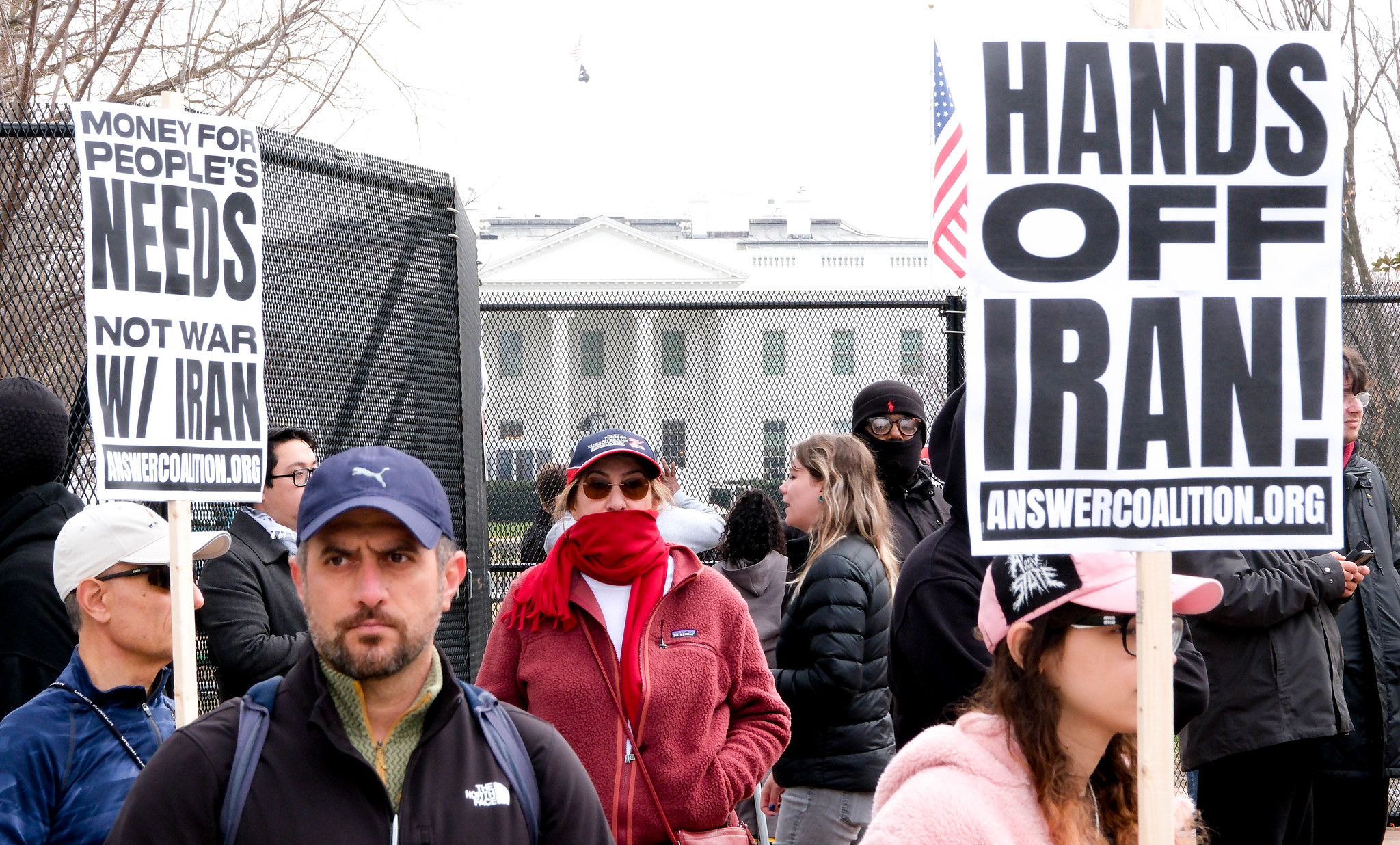
The Feb 28 US-Israeli military campaign
against Iran “Operation Epic Fury” never secured the approval of the US public
from the start.
The Trump administration was terribly short
of reason to explain the US public as to what strategic purpose the war will
serve. Operation Epic Fury lacked both, a clear objective and a clear
narrative.
A CNN poll conducted between Feb 28 and March 1, few
hours after Trump speech announcing the combat operation, found 59% Americans
opposing the war. A NBC News poll on March 5
found majority
of registered US voters disapprove of how President Donald Trump is handling
the situation in Iran and believe the U.S. shouldn’t have taken military action
against the country. Subsequent polls show a jump in disapproval rate as U.S.
military campaign against Iran progressed into second and third week.
A series of polls done in first week of April found most Americans saying there were not sufficient reasons to start the war
in Iran – with over 65% disapproving of the military strikes and just 26%
supporting it.
Opinion Polls in May under the shadow of skyrocketing gasoline prices in the
United States, consumer inflation at a 3-year high and a volatile stock market
were signaling peak warning.
Trump’s approval rate was down by
13.4% with strikes on Iran and by end-May had nosedived by 19.4% with 57.9 percent disapproving his leadership. Democrats
held a 5.5-point lead over Republicans in an average of national polls at
the end of February. By end-May, the gap had surged to 7.1 points.
With the crucial US mid-term election in November,
any “gamble” on the foreign policy front that hurts the American homes the
most, is never sustainable.